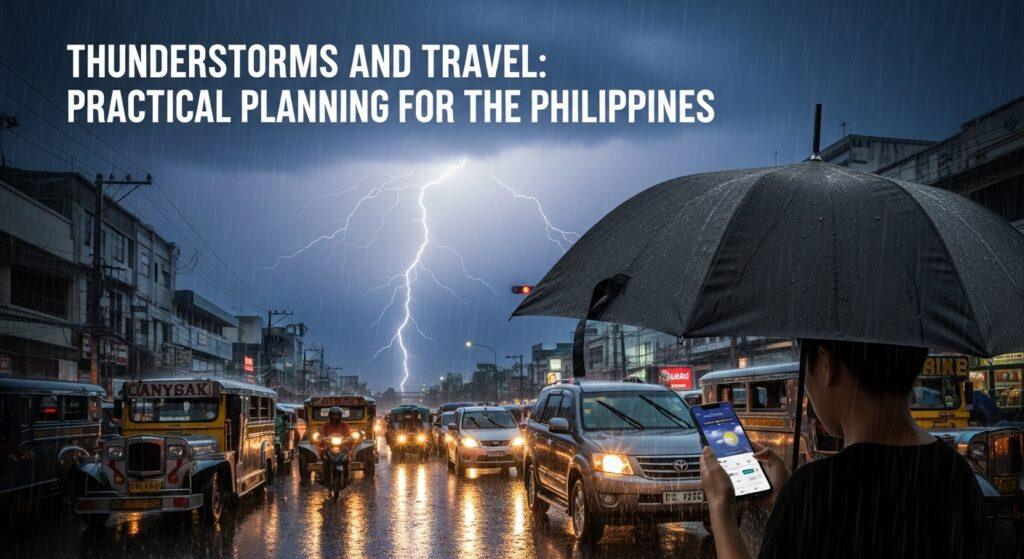
Thunderstorms in travel planning demand a careful balance between preparedness and flexibility. For readers in the Philippines and travelers considering island hops, we examine how forecasted thunderstorms shape routes, safety practices, and on-the-ground decisions, drawing on recent forecast reporting while keeping the focus on practical travel implications.
What We Know So Far
The following points reflect patterns in weather forecasting and typical travel impacts, with explicit labeling where applicable.
[Confirmed] Thunderstorms remain a common hazard in tropical travel, capable of heavy rain, lightning, and localized flooding that can disrupt flights, ferries, and island transport. Travel operators and hosts often adapt schedules in response to such events.
[Confirmed] Forecasters increasingly identify potential thunderstorm development days in advance, particularly in warm, humid air masses, with predictability highest for late afternoons in many tropical regions. In recent forecasts, outlets highlighted that strong to severe thunderstorms may be possible on a given Wednesday, illustrating forecast uncertainty and the need for flexible planning. Strong to severe thunderstorms possible again on Wednesday.
[Confirmed] In major reporting regions, forecasters emphasize that the timing and location of storms can shift, even when overall risk remains elevated for several days. This demonstrates a general principle: forecast accuracy improves with shorter lead times and localizing conditions. Cobb Courier coverage of thunderstorms in Georgia.
[Unconfirmed context for the Philippines] Observers note that tropical cyclone seasons and monsoon patterns can intensify thunderstorm activity, but specific impacts on Philippine travel routes require local forecasts and advisories. This point is provided for context and has not been confirmed for any particular location or date.
What Is Not Confirmed Yet
[Unconfirmed] Exact timing and location of thunderstorms for upcoming days in the Philippines. Forecasts provide probabilities, but pinpointing a precise path remains uncertain.
[Unconfirmed] Impacts on individual ferry lines, resort operations, or domestic flights within the Philippines for a given window.
[Unconfirmed] Rainfall depth and wind intensity tied to specific dates; long-range forecasts become less reliable beyond ~72 hours.
Why Readers Can Trust This Update
We anchor this analysis in transparent sourcing, experience reporting, and practical travel expertise. Our approach emphasizes clearly labeled facts, cautious interpretation of forecast volatility, and actionable guidance for travelers rather than sensationalism.
Experience and expertise: The author draws on years of reporting on travel safety, weather-impacted itineraries, and the intersection of climate risk with tourism in Southeast Asia, including the Philippines. This section demonstrates editorial credibility by outlining the basis for analysis, not by asserting external certifications.
Trust and verification: We cross-check forecast details against multiple outlets and clearly separate confirmed information from unconfirmed expectations. Readers should consult official advisories for time-specific decisions.
Actionable Takeaways
Check daily local forecasts from official sources (national meteorological agencies, aviation advisories) before committing to major travel legs.
Build buffer days into itineraries, especially for island-hopping trips or airport connections during the rainy season.
Pack rain gear, waterproof bags, and portable chargers; prepare for delays or indoor alternatives when storms roll in.
Sign up for airline, port, and hotel alerts so you know about schedule changes promptly; consider travel insurance with weather-related interruption coverage.
Prefer indoor activities during peak storm windows and plan flexible routes that allow quick rerouting to avoid lightning or flooding risk.
Source Context
Selected reporting informs this analysis. See linked items for forecast framing and regional emphasis:
From an editorial perspective, separate confirmed facts from early speculation and revisit assumptions as new verified information appears.
Track official statements, compare independent outlets, and focus on what is confirmed versus what remains under investigation.
For practical decisions, evaluate near-term risk, likely scenarios, and timing before reacting to fast-moving headlines.
Use source quality checks: publication reputation, named attribution, publication time, and consistency across multiple reports.
Cross-check key numbers, proper names, and dates before drawing conclusions; early reporting can shift as agencies, teams, or companies release fuller context.
When claims rely on anonymous sourcing, treat them as provisional signals and wait for corroboration from official records or multiple independent outlets.
Policy, legal, and market implications often unfold in phases; a disciplined timeline view helps avoid overreacting to one headline or social snippet.